Report of Integrated Training in Livestock Genetics, Genomics and Leadership for Sustainable Breeding Programs in LMICs

Dr. Chinyere Ekine-Dzivenu
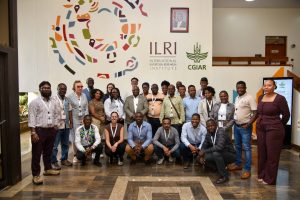
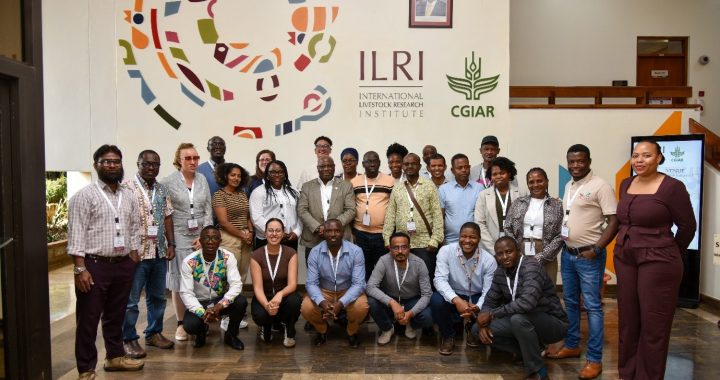
Picture 1. Training Cohort and Faculty: Participants and trainers at the integrated training on livestock genetics, genomics, and leadership held at ILRI, Nairobi (16–27 February 2026).


As part of my joint appointment, with 20% effort dedicated to the International Livestock Research Institute (ILRI), I participated in and contributed to an integrated training program on Genetic and Genomic Approaches for Livestock Improvement and a leadership-focused Training on Enhancing Capacity and Skills for Livestock Impact, held at ILRI, Nairobi, Kenya, from 16–27 February 2026. This program combined advanced technical training in animal genetics and genomics with leadership development, strengthening capacity to design and implement sustainable breeding programs and support livestock system transformation in the global south. The training was delivered by an international faculty drawn from leading research institutions, including the University of Alberta, the University of Edinburgh, ILRI, the Centre for Tropical Livestock Genetics and Health (CTLGH), and Scotland’s Rural College (SRUC), reflecting a high level of scientific expertise and global collaboration.

The technical component provided both theoretical and hands-on training in key areas of modern animal breeding, including phenotypic data analysis and linear models in R, pedigree-based genetic evaluation using BLUP, genomic data analysis with SNPs etc. I contributed through lectures, facilitation, and mentorship. I also moderated part of the African Animal Breeders Network (AABNET) book launch on African livestock genetic resources. which marked the release of “African Livestock Genetic Resources and Sustainable Breeding Strategies: Unlocking a Treasure Trove”.
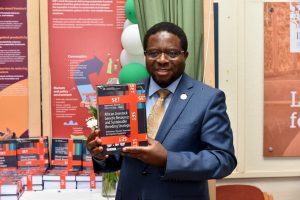
Picture 2. ILRI Leadership at Book Launch: The Director General of ILRI Appolinaire Djikeng holding the book African Livestock Genetic Resources and Sustainable Breeding Strategies: Unlocking a Treasure Trove during the AABNet book launch.


This book is the first to comprehensively present, in a single source, the diversity and uniqueness of African livestock genetic resources alongside sustainable breeding strategies and emerging technologies. The program engaged a diverse international cohort, with participants from over 25 countries across Africa and Asia representing academia, research institutions, government, and development organizations, thereby contributing directly to capacity building and livestock development in low- and middle-income countries.

Overall, the integrated training strengthened technical expertise, leadership and mentoring capacity, and international collaboration, while reinforcing partnerships between ILRI and the University of Alberta and Livestock Gentec. This engagement contributes to advancing livestock development in low- and middle-income countries through improved breeding strategies and knowledge transfer, while also enhancing the global research profile, partnerships, and impact of the University of Alberta and Livestock Gentec in the field of livestock genetics and sustainable agricultural development.
 

Knowledge and Technology Transfer update for the Swine team March 2026 update

Gentec Swine at the Banff Pork Seminar

The Gentec Swine Group kicked off the New Year at the Banff Pork Seminar (January 6-8th, 2026).

Our team presented three posters that highlighted latest results from our research collaboration with Hendrix Genetics Swine. Funded by NSERC Alliance, this work is focused on gilt development and sow lifetime productivity, with the goal of improving the competitiveness and sustainability of the Canadian pig industry.

We are proud of their achievements and dedication to their work!


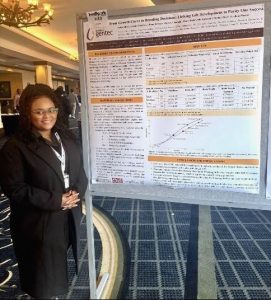
Sonja Allen (PhD candidate)

“From Growth Curve to Breeding Decisions: Linking Gilt Development to Parity One Success”

Sonja’s poster highlighted the opportunity to utilize gilt growth curve modeling, to identify key biological signals, to help time first breeding, which is essential for improving P1 outcome, sow retention, and profitability.


Kayla Patey (MSc candidate)

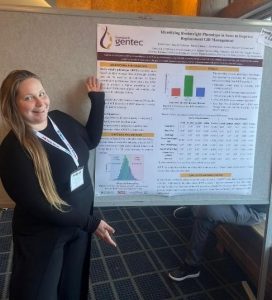
“Identifying Birthweight Phenotype in Sows to Improve Replacement Gilt Management”

Kayla’s poster explored the possibility of earlier selection against sows with low litter birthweight phenotypes (LBWP) to support more efficient gilt selection and herd management.


Morgan Rioch (BSc undergraduate student)

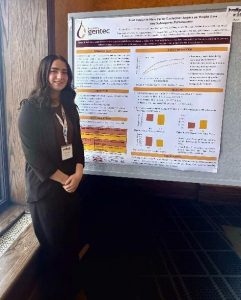
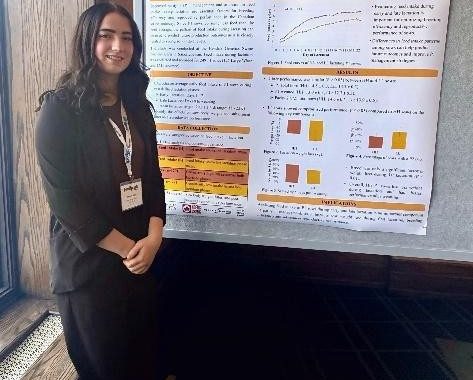
“Feed Intake in First Parity Lactation: Impact on Weight Loss and Subsequent Performance “

Morgan’s poster highlighted importance of feed intake during lactation in parity 1 sows as a critical component of parity 1 management, and how it impacts sow weight loss during first lactation, breeding efficiency and subsequent reproductive performance.


My experiences working with Gentec as an undergraduate and Master’s student

When I first joined the Livestock Gentec swine team in 2024 as a summer student intern and casual research assistant, I was in my 3rd year of my undergraduate degree at the University of Saskatchewan completing my BSc in Animal Bioscience. At that point, I had little hands-on experience in research, and limited knowledge about the swine sector. I gained so many valuable experiences during my first summer, that it was an easy decision to come back the following year in 2025. The support from the Gentec team was outstanding and I could not have asked for a better research group to work alongside with.

I assisted on the NSERC alliance project “Improving sow lifetime productivity and the number of quality pigs marketed per sow using novel phenotypes and genomics” led by Dr. Michael Dyck and Dr. Graham Plastow that is in collaboration with research partner Hendrix Genetics, Business Unit Swine, in Saskatchewan. The project is looking to identify the genetic and phenotypic relationships between different traits in order to improve sow lifetime productivity, profitability, and sustainability. My responsibilities included data collection and input, along with serving as the key point of communication between the barn and the team back at the University of Alberta.. My first year was focused on intensive data collection across various production phases. A key objective was utilizing gilt heart girth and flank-to-flank measurements to predict body weight through allometric relationships. I also collected weights in piglets at farrowing and at two weeks of age, and assisted with scale weighing during key production transitions for sows, including: training to breeding, gestation to farrowing, and farrowing back to breeding. During my second year, I got to dive more into the analysis side of things, and even conducted my own smaller study evaluating the effects of the number of piglets suckling through lactation and the impacts on subsequent performance. I worked alongside graduate students Sonja Allen and Kayla Patey as they joined me for short periods of time at the barn to work with the staff and see the data directly. I was very fortunate to work under the supervision of Jennifer Patterson who was a great mentor, providing me with invaluable knowledge and skills that I will continue to carry forward in my career.

I am especially grateful for the opportunity to participate in the Banff Pork Seminar. I volunteered in my first year attending this event, getting my real firsthand look into the swine industry and had many great discussions with industry leaders, researchers, and producers. Earlier this year in January, I was given the chance to attend the conference again, this time presenting a poster of my own:  “Feed Intake in First Parity Lactation: Impacts on Weight Loss and Subsequent Performance in Swine.” Without the support from Gentec, exposure to this level of research would not have been possible.

My time with the Gentec swine team is what ultimately drove my passion for research and what led me to become a graduate student at the University of Alberta. I joined the Gentec beef team January of this year and began my grad studies under the supervision of Dr. John Basarab, joining the project “Reducing Greenhouse Gas Emissions from the Canadian Beef Industry through the Development and Adoption of Genomic Tools”. My study will be looking at use of portable NIRS on fresh fecal samples as a proxy measure to predict enteric methane emissions from beef cattle. Our aim is to develop a low-cost measurement tool that will allow for large-scale collection in the industry. I am so grateful for the opportunities and training I have received during my time with Livestock Gentec so far, and I am excited to see what the future brings with my current research. It is evident after working with each of these groups here at Gentec how much pride the group takes in its work and in providing producers with accurate, relevant data that supports informed management decisions.

Highlighting collaborators: Cow Calf Health Management Solutions

Livestock Gentec is very lucky and grateful to have excellent partners in industry and elsewhere. It is sometimes difficult to give proper credit to those who contribute to our successes. However, when we can, we take the opportunity to highlight excellent collaborators and share some of their contributions to our projects. The team at Cow Calf Health Management Solutions (CCHMS) led by Dr. Waylon Wise, are excellent industry partners and are key to the success in some of our current projects. CCHMS, are a beef cattle veterinary animal health group in Alberta with a focus on cow calf operations. Dr. Wise and his team are directly involved in the pilot projects for two of our projects with Dr. John Basarab as the PI: “Using genomics to improve the profitability and sustainability of Alberta’s beef industry” Sustainable CAP funded administered by RDAR and “Reducing Greenhouse Gas Emissions from the Canadian Beef Industry through the Development and Adoption of Genomic Tools” funded through an NSERC-SSHRC Alliance grant in sustainable agriculture.

The CCHMS team promotes innovative practices to their clients in areas they know can add value to producers. Where Livestock Gentec is concerned, they have promoted and coordinated the execution of our genomic tools pilot projects with their clients. This has significantly extended our reach, and provided a convenient means for producers to get involved in our projects through facilitating tissue sample collection and shipping. Caylee Dorval, account manager with CCHMS, has been an excellent support in coordinating the sample submission and phenotype compilation. For the Gentec team, this means we can receive consistent and detailed records for their animals to support our goals of validating and improving our genomic tools.

To help put this support into context, CCHMS has coordinated the sampling from 9,328 animals and supplied raw phenotype data for many of these cattle in our pilot projects. The pilot project for the NSERC-SSHRC alliance grant requires more data collection from the producer side such as feeding and management data. Always the innovators, Dr. Wise and team are implementing a new data collection platform with pilot producers that will simplify the entry and analysis for these data. We are using these data to estimate on farm GHG reductions through the implementation of genomic tools as a beneficial management practice.

Here’s a quote the CCHMS team shared with us on our collaborations:

“Cow/Calf Health Management Solutions (CCHMS) has had an excellent opportunity to work with Livestock Gentec on the Genomic Tools Project. This collaboration has helped bridge the gap between producers and genomic research. CCHMS specializes in boots on-the-ground support, helping producers learn DNA sample collection and track chuteside data using the herd management software tool, Herdtrax. For animals enrolled in the trial, CCHMS facilitates the extraction and communication of the raw data collected by the producers to the research team to improve genomic predictions. Livestock Gentec has seamlessly provided us their genomic data—including gEPDs, Breed Composition, and parentage results—with a quick turnaround time. The funding and genomic data have greatly benefited commercial producers by helping them make more informed decisions regarding replacement selection and sorting targeted mating groups. CCHMS is delighted to participate in the collaboration with Livestock Gentec and looks forward to incorporating genomics into our consultation service model.”

Aside from the direct support to our project goals, Dr. Wise has a very keen sense of what industry needs. As CCHMS has many clients representing a diversity in scale and approaches, the team is a very good sounding board for new ideas and how best to approach our projects and goals. Livestock Gentec aims to grow adoption of genomic tools in the beef cattle industry Dr. Wise and his team at CCHMS are key partners in achieving this goal. We hope to continue this strong collaboration.

Knowledge transfer road trip: Highway 13 Cattleman’s annual showcase 2026

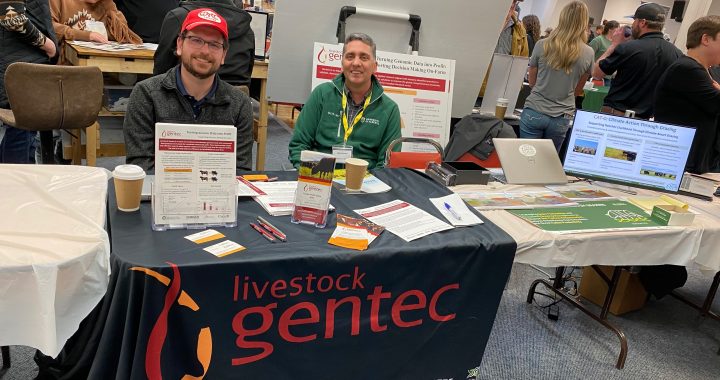
Project manager Jordan Roberts took a “quick” trip out to Czar, Alberta for the annual show case of Highway 13 Cattlemen’s club. The event featured a variety of exhibitors representing seed stock, animal health, equipment and livestock organizations just to name a few. Also a guest speaker presented some very interesting information on Johne ’s disease in cattle. We joined our colleagues and collaborators from ALES faculty at University of Alberta representing the Climate action through Grazing (CAT-G) team. Dr. Majid Irvani, Dr. Xiaoli Fan, Dr. Huan Chen, from the CAT-G team were in attendance to share their expertise on soil health and discuss practices with producers in attendance.

It was a very full day speaking to folks on our genomic tools projects and sharing how producers can get involved in Livestock Gentec projects. We were impressed with the knowledge from some of the producers we spoke to about genomic tools. The youth club with Highway 13 cattlemen had actually conducted a genomic assessment of a member’s animals using commercially available genomic testing. That was a great jumping-off point for discussions as many members –youth and adult alike, had some exposure to genomic testing. This led to some great questions and discussions around the Livestock Gentec approach to assessing genetic merit. For example, we were able to highlight the use of genomic breed composition and retained heterozygosity to improve replacement heifer selection and breeding groups. We had many opportunities to invite producers to participate in our pilot project for “Using genomics to improve the profitability and sustainability of Alberta’s beef industry” (Sustainable CAP funded RDAR administered, PI, Dr. John Basarab; Livestock Gentec CEO). This project provides an attractive opportunity for producers who are interested in the technology through the incentivized genotyping and analysis we can offer (read more here).

We took a break from talking to listen to the very interesting presentation on Johne’s disease or paratuberculosis given by Dr. Marie-Lucie Gendron of Border Veterinary Clinic. Johne’s disease is a contagious, incurable, and chronic bacterial infection caused by Mycobacterium avium subspecies paratuberculosis (MAP). Dr. Gendron shared some great information about the clinical signs of the disease, it’s progression and prevalence in Alberta. She also detailed a number of practical steps producers can take to ensure the spread is limited. Some highlights from the prevention side include: PCR testing, when a cow is suspected, good biosecurity and cleaning practices along with colostrum replacement for calves from positive cows. It is always great to keep informed on the diseases that can afflict cattle and how best to prevent and control the disease.

Overall, this was a very valuable event to attend. While it was a bit of a trip for us, the excellent beef on a bun and chilli served for lunch kept up our energy levels. We hope to continue to engage with the Highway 13 cattlemen’s club for future events. We are also excitedly anticipating new producers enroll in our pilot project!


Livestock Gentec Barriers to Adoption of Genomic Tools Survey invitation

In the project: “Reducing Greenhouse Gas Emissions from the Canadian Beef Industry through the Development and Adoption of Genomic Tools” (Awarded to Dr. John Basarab project PI through a NSERC-SSHRC Alliance grant in sustainable agriculture), one of our goals is to better understand the barriers to adoption of genomic tools for beef producers. To accomplish this, we are engaging producers directly. Project co-applicant Dr. Xiaoli Fan and PDF Dr. Huan Chen have developed an online questionnaire to gather insights on awareness, attitudes, barriers, and potential support needs related to the adoption of genomic technologies by Canadian cow-calf producers. These findings will inform future research and policy initiatives that support the use of genomic tools to improve the profitability and sustainability of the Canadian beef industry. The survey takes about 20 minutes to complete and results are anonymous. We invite Canadian beef producers reading this to participate, use this link or the QR code below to access the questionnaire.

This project is exploring several approaches to address the use of genomic tools for the reduction of greenhouse gas (GHG) emissions from the Canadian beef industry. As a large multi-institution project, we can approach the challenge of reducing GHG in beef production from multiple angles utilizing the expertise of our various excellent team members. Here we will overview the project to show how this questionnaire fits into our project framework.

First, we are developing novel genomic tools such as genomic enhanced Expected Progeny Difference (gEPDs) for enteric methane emissions to factor into a sustainability multi-trait selection index. These genomic tools can help quantify GHG emission reductions through selection decisions by selecting for lower emitting and more efficient animals. You can read about the animal trials being used to develop the phenotypic dataset for this goal here. To enhance the capability of enteric emission phenotype collections from beef cattle, we are also developing a proxy measure for enteric emissions by using fecal near infrared spectroscopy. The feasibility of this approach was originally assessed by our project collaborator Dr. Amélie Vanlierde with Walloon Agriculture Research Centre (CRA-W, Gembloux, Belgium). This has shown promise as a suitable proxy measure for enteric emissions. This will allow for low cost phenotype collection for enteric emissions to supplement the present project dataset and future efforts to quantify enteric emissions (read our previous article on the topic here). Next, we are developing a carbon offset framework for cow calf producers to incentivize adoption. In the regulated or voluntary carbon markets, industrial emitters can purchase “offset credits” associated with reductions from quantified projects to lower their net emissions. More simply put, this is a framework that can result in producers getting paid for practices that reduces GHG emissions. Beneficial management practices (BMPs) are being developed to help producers understand how to apply genomic tools in their operations for better sustainability and profitability outcomes. These BMPs will tie into the carbon offset protocol development. Finally, these practices are being piloted by cow calf producers to support adoption. By working with the producer partners and analyzing the data they supply, we can quantify the economics and GHG reduction achieved and projected through the pilot project work. To read more about the pilot project and to get involved read more here.

We are grateful for the opportunity to lead this large scale project. We can only be successful in our goals with the participation of Canadian beef producers. This survey and the activities of the producer pilot are great ways to stay informed on the developing approaches and have your voice heard in the process. Please feel free to reach out with any questions! lsgentec@ualberta.ca


RDAR Research Showcase 2026 Summary


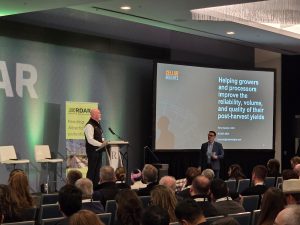
 Results Driven Agriculture Research (RDAR) hosted its fourth annual Research Showcase in Edmonton on January 21st. Nearly 400 individuals involved with Alberta’s diverse agriculture industry attended, showing how much interest there is in hearing the latest developments in agriculture research and innovation. The event featured presenters and a selection of specially chosen research projects, all highlighting the impact RDAR is having on agriculture research and development, not just in Alberta, but across Canada. 

RDAR’s Research Showcase is being consistently viewed as an important industry event, which has been reflected by the year-over-year growth in attendance, with an approximate 25% increase over 2025. 

Another indicator in the event’s popularity is interest in researchers wanting to showcase their work. Twenty-two projects were showcased this year, highlighting a variety of projects, including: 

• defining optimum seeding rate for new feed barley varieties 

• Field border delineation using imagery deep learning for advancing digital-first ambitions in crop insurance 

• Genome wide association study to identify markers for stripe rust virulence and resistance in diverse Canadian wheat panels 

• Assessment of the population structure of E. coli O157 from cattle and associated food safety risks 

• Developing an antimicrobial resistance surveillance program for bulk tank milk 

• Expanding opportunities for Western Canadian faba bean (Vicia faba) as a feedstuff for broiler chickens and laying hens and mineral composition of Alberta pasture grass over the grazing period 

• Engineering Next-Generation Phages to Protect Dairy Calves from Johne’s Disease 

The full list of projects and the presenting researchers may be viewed here. 

A short program, hosted by Real Agriculture’s Shaun Haney, complemented the poster presentations. Greetings from the Government of Alberta – from both the governing United Conservative Party and the opposition New Democratic Party – illustrated non-partisan support for agriculture in Alberta. A fireside chat with Alberta Agriculture and Irrigation’s Deputy Minister Jason Hale also showed the support the Department has for RDAR and its initiatives. Two significant projects were highlighted, and a producer panel discussing the benefits of on-farm research rounded out the program. 

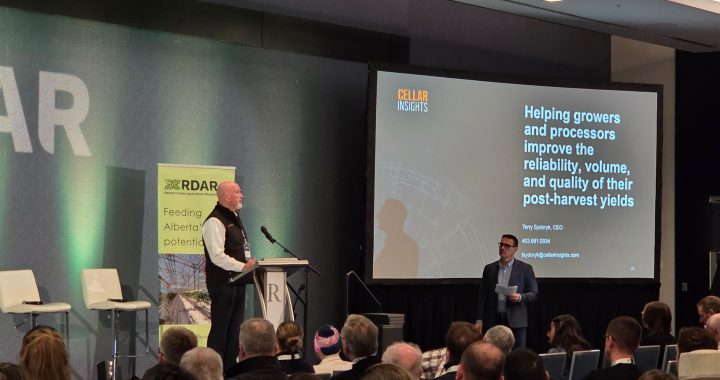
The first highlighted project presentation was from the CEO and co-founder of Cellar Insights, Terry Sydoryk. He has over 25 years of senior leadership experience building and scaling companies in Canada’s innovation ecosystem. Cellar Insights is an ag tech company that uses advanced sensing and cloud analytics to help potato growers protect crop quality and maximize marketable yield in long-term storage. Cellar Insight’s potato storage solution helps potato growers reduce post-harvest losses through evidence-based storage management. By translating real-time data into practical decision making, this project supports more efficient use of inputs, protects producer revenues, and advances broader policy objectives related to food security, waste reduction, and climate-smart agriculture.

The second featured project presentation was delivered by Kim Sturgess, founder and Vice President of WaterSMART Solutions Ltd., a services organization committed to improving water management through better technologies and practices across western Canada and beyond. Kim has led the development of collaborative watershed management models and systems over the last 20 years and has supported water management planning in industry and government. 

WaterSMART’s work on creating operating models for irrigation districts provides a roadmap for water use efficiency by advancing data-driven decision tools, scalable best practices, and adaptive management strategies. The roadmap supports sustainable irrigation policy objectives by helping producers optimize water allocation, enhance drought preparedness, and safeguard ecosystems. It is also used to advocate for policy changes with both municipal and provincial governments. 

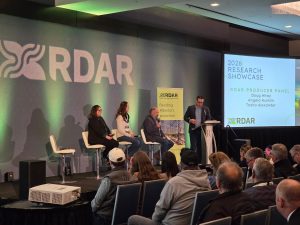
The final segment of the program was the RDAR Producer Panel. Three Alberta based producers were invited to speak to the audience about their experiences with adopting new innovations on farm, as well as exploring their past interactions with the research community. Doug Wray, Angela Kumlin, and Tasha Alexander participated in the conversation with Shaun Haney. All three stressed that researchers need to listen to producers about the challenges they are facing and identify proposals and solutions that will rise to meet these. Moreover, all stressed that solutions need to be practical and feasible, and trial and error is the general “research” done on farm. 

RDAR now looks forward to delivering its summer event – Round-Up on June 17th, when the organization will take a more practical and producer focused look at the benefits of early adoption and on-farm innovation in Alberta. 

If you would like to view the RDAR Research Showcase, in part, or as a whole, please follow these links: 

• The 2026 RDAR Research Showcase can be viewed in full here. 

• The Cellar Insights presentation can be viewed here. 

• The WaterSmart presentation can be viewed here. 

• The RDAR Producer Panel can be viewed here. 

• To see the selected poster projects for this year’s Research Showcase and to learn more about the researchers involved, click here . 


Gene Edited and Cloned Livestock Approvals

In January this year Health Canada and the Canadian Food Inspection Agency (CFIA) approved pigs produced by gene editing to be resistant to porcine reproductive and respiratory syndrome (PRRS) viruses for use in food[1],[2]. Canada joined the US, Brazil and some other countries in determining that these pigs are as safe as conventional pigs used to produce food. Gene editing enables precise changes to be made to the DNA of an organism to change its phenotype. In this case to breed pigs resistant to PRRS, a devastating disease. PRRS is estimated to cost the Canadian industry $180 million3 and US industry $1.2 billion4 annually. Scientists Emmanuelle Charpentier and Jennifer Doudna were awarded the 2020 Nobel Prize in Chemistry for developing the tool or “molecular scissors” that was used to generate the PRRS resistant pigs. Other gene edited livestock include cattle that are more heat tolerant. These cattle are approved for sale in the US, however, they are not yet approved in Canada.

Will we be eating pork from these pigs soon and if so will we know? Health Canada states that as they found no health and safety concerns, no special labelling is required for foods from the PRRSV-resistant pigs. We have featured articles about this topic previously in the newsletter (see for example genome editing opportunities in agriculture, and  here, here, here, and here).

Former CEO Graham Plastow was invited to forecast the future of gene edited livestock at the Visions III conference on animal genetics and genomics at Iowa State University in 20215. His paper “who is going to eat ChickieNobs6?” after the engineered, brainless chicken parts in Margaret Attwood’s “Oryx and Crake”, looked at what would be required for successful introduction of these novel gene edited foods. “The opportunities for new technologies in animal genetics and breeding are not derived from the precision of the technology, the nutritional equivalence of the products, or whether such products can be distinguished from conventional products. They come from the benefits they bring to consumers and why scientists and businesses want to provide them. Shared value takes into account a broader set of societal needs and not just economics. Taking this approach can help companies to look at potential problems that will create barriers or “hidden” costs for taking technologies to market. Giving consumers the choice to determine how they benefit from these opportunities can help create markets rather than approaches that push technology first and create hurdles and objections.”

___________________________________

[1] https://www.canada.ca/en/health-canada/news/2026/01/canada-approves-pigs-resistant-to-porcine-reproductive-and-respiratory-syndrome-viruses-for-use-in-food-and-feed.html

[2] https://www.canada.ca/en/health-canada/services/food-nutrition/genetically-modified-foods-other-novel-foods/approved-products/porcine-reproductive-respiratory-syndrome-virus-resistant-pigs/document.html

3  https://www.ahwcouncil.ca/pdfs/AHC_Gaps%20Analysis%20Report_February%2013_EN.pdf

4Osemeke, Onyekachukwu, et al. “Economic Impact of Productivity Losses Attributable to Porcine Reproductive And Respiratory Syndrome Virus in United States Pork Production, 2016 to 2020.” Preventive veterinary medicine (2025): 106627.  https://www.sciencedirect.com/science/article/abs/pii/S0167587725002120

5https://genetics.org.uk/events/visions-iii-star-gazing-into-the-galaxy-of-animal-genetics-and-genomics/

6 Margaret Attwood, “Oryx and Crake” p202, 2003 McClelland & Stewart Ltd. Toronto.