
By Seyed-Hassan Miraei Ashtiani, PhD, Dalhousie University (supervisor Dr. Ghader Manafiazar)
In August, I had the opportunity to attend the Canadian Beef Industry Conference (CBIC) in Winnipeg, Manitoba, where I presented our initial work on using fecal near-infrared (NIR) spectroscopy and machine learning to predict enteric methane emissions from cattle. It was a valuable opportunity to share our early findings with people from across the beef industry and to discuss a practical question at the center of our research: how can methane phenotyping be expanded to many more animals?
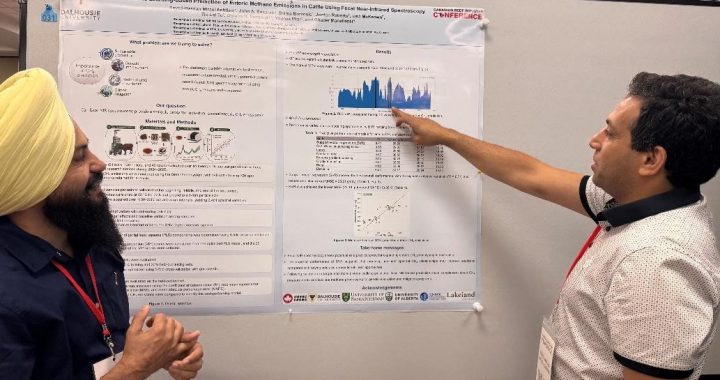
Presenting our initial research findings at the Canadian Beef Industry Conference in Winnipeg, Manitoba.
Direct measurements are essential for understanding differences in methane production among individual cattle and for building the reference populations needed for genetic evaluation. GreenFeed systems allow researchers to collect these measurements from individual animals, but the specialized equipment and repeated measurements required make large-scale data collection difficult. Fecal NIR spectroscopy is being investigated as a potential proxy that could help extend methane phenotyping beyond the number of animals that can be measured directly.
The process is simple: scan a fecal sample and use its spectral information to predict methane production. Behind that simple workflow, however, is a more sophisticated modeling task. Each spectrum contains information across hundreds of wavelengths, and machine learning is used to identify spectral patterns that are most informative for methane prediction. The models learn these relationships using cattle for which both fecal NIR spectra and direct GreenFeed methane measurements are available. Their performance can then be evaluated using animals that were not used to train the models.
The workflow below shows how direct methane measurements from GreenFeed are connected with fecal sample preparation, NIR spectroscopy, and machine learning prediction.
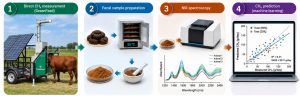
Study workflow from direct methane measurement and fecal sample preparation to NIR spectroscopy and machine learning prediction.
At CBIC, I presented results from the first available dataset with samples from 146 animals. We compared eight regression approaches, and support vector regression performed best, explaining 71% of the variation in methane emissions in the test data, with a prediction error of 28.21 g/day. These are encouraging early results, but they represent a starting point rather than a finished prediction system.
Our research is part of a larger five-year project: “Reducing Greenhouse Gas Emissions from the Canadian Beef Industry through the Development and Adoption of Genomic Tools” (PI, Dr. John Basarab, NSERC-SSHRC Alliance grant funded). The project plans to collect individual methane and carbon dioxide measurements from more than 2,300 cattle across five research sites in Canada, along with feed intake records, fecal samples, genomic information, and other animal measurements. As these data become available, they will provide a much larger and more diverse dataset for developing and evaluating methane prediction methods.
This growing dataset is important not only for testing the current prediction models, but also for developing better ones. As the number and diversity of animals in the dataset increase, the prediction methods can continue to evolve. We will be able to refine the models, examine how well they perform across different cattle populations, diets, research sites, and production conditions, and investigate additional methane-related traits. The project also provides opportunities to explore how NIR spectra can be combined with performance and genomic information to improve prediction.
The aim is therefore broader than finding one algorithm that performs well on the current dataset. The project is evaluating whether fecal NIR can become a practical proxy for methane production in commercial cattle while continuing to expand the population with directly measured methane phenotypes. Those direct measurements remain central to building the reference population and developing and testing molecular breeding values for methane traits.
Presenting our initial findings at CBIC was an important milestone, but much of the work is still ahead. As the reference population grows—we have completed trials with 850 animals, so will the information available to develop, refine, and validate the prediction methods. The next stages will help determine how well the approach performs and whether it can provide a practical way to expand methane phenotyping at scale. In the longer term, this could strengthen the phenotypic resources available for genetic evaluation and support selection for reduced methane emissions in beef cattle.
Read other articles about this project here and here