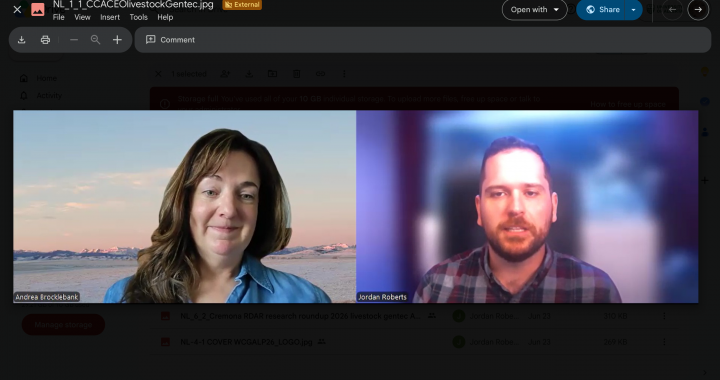
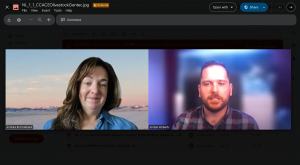
Below is a transcript from the conversation between Andrea Brocklebank CEO of Canadian Cattle Association and Jordan Roberts Livestock Gentec project manager that took place online May 28, 2026. We covered a lot of ground in a short time. We covered topics such as Andrea’s path to the role of CEO, her history with research, priorities for industry, furthering adoption of research, and sustainability.
If you want to watch the video of our conversation please use this link
The full interview is worth a watch, listen or read. Andrea had some very salient wisdom for those working with beef producers in adoption of new technology we summarize here.
- First, make new information simple for producers to understand, in her words: “…making it tangible and in bite-sized pieces that they can look at how they adopt and implement is really important”. Producers are busy people, getting them to understand how to apply new and complicated technology –like genomics–is a big ask. Simplifying the message goes a long way.
- Next, “meeting people where they are”. Andrea used this phrase multiple times and in multiple contexts in our conversation. In the context of adoption, I think this excerpt captures the point perfectly:
- “When you are overwhelmed, really busy, and something complex is in front of you …you’re much more likely to set it aside than if we can create understanding and build learning and work with them to move forward incrementally.”
- Last point, Andrea had some very practical guidance on an effective strategy to improve the efficacy of knowledge transfer:
- “You have to hit producers multiple ways and multiple times to actually ensure that they are willing to consider it… They think about it for a while and then if they see it again they probably contemplate and dig a bit deeper, then they probably talk to some neighbors, and then they look at implementation. With that, it is making sure that there is resources all the way along that continuum available to them.”
- We think this strategy is an effective one that address how most of us take on new information. Having multiple opportunities and modes to share the information creates familiarity and accommodates different learning styles. Then, by having the resources readily available those wanting to learn more know where to go and can dig in themselves!
Interview Transcript
Jordan Roberts: Hello everyone. Today we are lucky to have a very special guest. We are joined today by Andrea Brockbank, CEO of Canadian Cattle Association. Welcome Andrea and thank you very much for taking the time to chat today.
Andrea Brocklebank: Thank you.
Jordan Roberts: To start us off, could you please share a bit about your background and the journey that led you to the role of CEO at the CCA?
Andrea Brocklebank: I was born and raised southwest of Calgary, west of High River, Alberta on a mixed farming operation. We had cow calf and crops. I knew I always wanted to be in agriculture, so I decided to go off to school and did a bachelor’s degree in agriculture economics at Lethbridge and then a graduate degree at University of Saskatchewan in agriculture economics. When I left there, I worked in the banking and feed lot sectors throughout my university years and I was interested in the cattle industry. I’ve always loved the cattle industry and my thesis was on supply chains in the cattle industry. I decided to reach out to the Canadian Cattle Association. It was 2004, so the height of the BSE crisis and I got a job managing some project funds for them. Long story short, 21 years later, that job has evolved — I moved into managing the Beef Cattle Research Council. At that point, it was just a halftime position, it was just me, and I was able to grow the BCRC to where it is today where we really added the mandate of extension and with a lot of provincial engagement on demonstrating the value of research investments we were able to increase our project portfolio. When I started, we probably funded about three research projects a year, whereas I think the BCRC project inventory has grown to over 100 projects that they’re funding at any one point in time. I really liked what I was able to do at the Beef Cattle Research Council and when the CCA CEO job came up I decided to put my hat in the ring. I see all of the important work done at the Canadian Cattle Association related to policy and all of the operational divisions that we have and just wanted to make sure that we could continue that moving forward and saw the opportunity to expand what I had done on the research side into policy and all of the other areas.
Jordan Roberts: Excellent, you mentioned your time with the BCRC and obviously the CCA has a much broader scope. How do you think your role and time with the BCRC will influence and affect your role with CCA?
Andrea Brocklebank: You know, science has always underpinned CCA’s approach to policy. There’s always been a focus on science-based policy but also how we work with our public and stakeholder engagement division and even with the Canadian Roundtable for Sustainable Beef — that interconnection of all of the groups related to policy and sustainable beef and our public groups I think has been strong and I just look to continue that. Not going to lie, I have always advocated for research funding and infrastructure and those types of things and I think I’m going to continue to hold that close to my heart at CCA and make sure it’s done. It is an interesting timing because I moved into the role right around the same time as Ag Canada announced massive research cuts, which was very unfortunate and something we’re continuing to navigate. My goal — BCRC is very much focused on the funding and implementation side. They actually cannot lobby based on the rules around check off. I think that’s CCA’s role to make sure that we are advocating on behalf of the industry for stability of not just research investments, but making sure we have research infrastructure and capacity moving forward. If Ag Canada proceeds as intended, I think one of our key messages at this point is the fact that we need to make sure that there is adequate programming funding and capacity for our universities to fill those gaps. Right now, most universities are already challenged with funding so they cannot do that based on existing budgets — it would have to look at new funding.
Jordan Roberts: Yeah, that’s a great point and very challenging and interesting times in the research landscape. Hopefully with some advocating — not lobbying — from yourself and CCA, there’s some additional supports to help bridge that gap or maybe even reverse course. With that, what are your priorities in this role? More generally, what do you view as the major priorities for the Canadian industry right now?
Andrea Brocklebank: It depends on the day you talk to me right now, but we are always going to have the same thematic priorities when it comes to policy related work and it falls under what our committees are.
Trade— we export 50% of what we produce, trade is a big one, and we are working on two areas right now. One is the renegotiation of our largest trading agreement with the Canada-US-Mexico Free Trade Agreement and then also concerns about cheap imports coming in through Mercosur and uninhibited trade, which is a concern in that dynamic. That being said, we are looking at the renewal of the next 5-year funding framework with the federal and provincial governments, and that is a big deal across everything from research to business risk management programs for producers to access and overall funding for programs. That one just continues to be something we are making sure we are at the table and communicating on what works and what does not. We work really closely with the provinces on that.
The other two areas that are always present are animal health files — the big one in the last year has been traceability and discussions on how our industry moves forward. We are making sure it is very clear that we are working with producers on that and our provincial stakeholders to develop a plan as to what industry is comfortable with.
There is also areas like environment where we just need to continue to move forward. We’ve made a lot of inroads in terms of building public trust and that’s partially through science and demonstrating the positive impacts we can have on the environment and also how we’re mitigating those negative impacts. That sounds like a big list of priorities, but there is a big team involved to make sure to deliver them. My job is to really just make sure that we are navigating through those.
With that being said, I stepped into CCA at a time where we are also going through a big transition in our structure, based on our provincial membership asking for change. The CCA structure has not changed for over several decades really, in terms of how we approach member representation and those issues. We’re also working on that as we speak and I would say it’s going positively in the sense that all of the provinces have agreed in principle to a plan, but we just need to now get the governance laid out and the structure done.
Jordan Roberts: So you hit the ground running, really?
Andrea Brocklebank: I did. Yeah.
Jordan Roberts: Excellent. Okay. So in our world — Livestock Gentec’s world — we see (obviously) research and innovation as a priority and specifically our focus and bias is towards genomic tools and we see those as keys to improve productivity in the beef industry. How do you see science and technology shaping the future of the beef industry?
Andrea Brocklebank: Well, I’ve used the line — and I know our BCRC team does too — there’s no silver bullets to the challenges in front of us, but it’s about constant incremental improvements and changes and you know that’s where we really need to approach it from all different levels. We need to increase productivity, which is the biggest one. Our land base for cattle production or agriculture production is not increasing — in fact, it is decreasing. It is always about the focus of producing more per acre and more per animal. I think genomics is one of those tools that has a valuable opportunity to help with that alongside all of the other areas of research, including increasing forage productivity, yields, those types of things.
From my perspective, it is just imperative that we continue on all fronts in innovation and research, but also then making sure it actually gets adoption, which is a big part of what the BCRC really focused on — getting information to producers so they can make decisions. We have seen that too where producers have moved away from cattle production in the past when crops were more profitable. Obviously we’re in a bit of a different dynamic now with very strong cattle prices, but we want to make sure producers feel like they can grow sustainably and for the long term, not just be in the short-term market opportunities. That is where I think I see huge opportunities to continue to improve our herd, not just from the animal side, but also the forage and feed side is a big area as well.
Jordan Roberts: Maybe on a little bit more of the low tech side — you’re probably familiar with the saying “you can’t manage what you don’t measure” — but in our experience working with producers on adopting some of this technology, we are finding producers still struggle with recordkeeping as one of the basics. How important do you think that is to improving productivity, and is there also a role for technology to help support producers in that data collection aspect?
Andrea Brocklebank: Absolutely. BCRC has several modules, courses, and information sheets on recordkeeping. I think what we have heard from producers in the past is they tend to lean toward “I have to have a perfect system” — and it is like, no. I think keeping it simple actually applies in this case. We have really tried to focus through the BCRC in terms of what are the key records you need to keep to actually help your decision-making processes. Not having a perfect system, but perhaps tracking the top four or five things you need to monitor and encouraging producers to start small and simple — they can grow from there.
In terms of technology, I think AI is proving its potential. I never thought I would be using it, but I am using it on the regular for different purposes and testing it out. But again, sometimes producers think if they don’t have a certain software — and Excel spreadsheets work for a lot of this if they want to start small. We really have recognized we need to meet the producer where they are at and make sure they are comfortable with what they are tracking and that it is sustainable, because you can develop a fancy spreadsheet but if you do not populate it regularly, you are back at square one. I would just encourage — there is a lot of resources on beefresearch.ca that have been helpful even in our own operation. One of the things I always recognize, especially on the cow-calf side, is a lot of farm operators also work off farm. We have to be honest about what time they have available and make sure it is focused on things that have meaningful impact for them on farm.
Jordan Roberts: I am glad you mentioned the BCRC and their efforts towards knowledge transfer and the resources available. So that kind of leads right into the next question about bridging the gap between research outcomes and on-farm adoption. That is always a challenge. How do you think we can continue to improve that and actually speed it up, and who are the key players in that world?
Andrea Brocklebank: You know, I am not the best one to speak on this — BCRC definitely would be. In terms of they spend a lot of time thinking about not just what the great materials are but actually looking at analytics in terms of what resonates with producers and what the uptake is of various things, and that has really helped them target where they produce more information or try different approaches.
One of the lessons Tracy, who’s now the interim executive director of BCRC, taught me was you have to hit producers multiple ways and multiple times to actually ensure that they’re willing to consider it, because there’s a decision-making process, right? They think about it for a while and then if they see it again they probably contemplate and dig a bit deeper, then they probably talk to some neighbors, and then they look at implementation. With that, it is making sure that there is resources all the way along that continuum available to them. One of the things my background really brought to BCRC was the economics piece — it is great to have the science, and producers often will believe in a technology, but if they are not sure about the economics and the impact and what the payoff timeline is on their operation, that is often where they will stop. So some of the simple decision-making calculators that BCRC has, or even some of the provinces have, I think are really important to help producers. They are not perfect and they are not attuned to every operation, but they give at least a framework for producers to consider what the costs, time, impact, and payout is of these technologies moving forward.
Jordan Roberts: Just as a follow-up — do you see a lot of uptake from those calculators from the metrics you can see?
Andrea Brocklebank: We do. I do not have the specific metrics — that would be a BCRC-specific question — but I know in the past where we have seen lower use we have realized that sometimes we need to alter them. So some of the calculators have gone through refreshes at points in time. Some are used more than others too, and I think that just shows where producers are trying to key in on different decisions. For sure, they have been quite helpful in just giving producers that additional look at approaching different technologies and investments in their operations.
Jordan Roberts: Changing gears a little bit, you have mentioned that improved productivity is always going to be the number one priority. However, sustainability seems to be a growing focus among policy makers, consumers, the international market, and researchers. Could you speak briefly to how the Canadian beef industry is positioning itself in that conversation?
Andrea Brocklebank: Yeah. You know, honestly, back around 2010 we did not invest substantially in those areas of research. Environment was viewed to be a public good and therefore the government should do that work, and industry — with limited dollars — did not spend a lot. I think with growing questions around public trust and sustainability we started to do the first environmental footprint of beef production to understand what the improvements have been over the last 30 years and to have a better understanding of our role and contributions to things like carbon sequestration and biodiversity. We also recognized we needed science around things like animal welfare and big questions like animal transport, because if there is not science when policy comes up, it needs to be informed by science if we’re going to have a productive and sustainable industry. So over the last few decades we’ve grown to understand that yes, we are going to fund productivity work, but industry also needs to look and make sure there’s science to inform some of these discussions related to public trust and policy that ultimately circle around things like sustainability and animal welfare.
To the point that we renewed the environmental footprint of Canadian beef production — that was done again and is being done on a five-year basis now — and really trying to strategically invest more research in certain areas like biodiversity and understanding of the importance of grasslands. That being said, one of the things BCRC quickly realized, once we kind of had the baseline or the benchmarks for that work was: let’s not just fund that work separately. If we are doing grassland research or forage productivity research and we can take those measurements, or we are doing cattle research and we can take methane measurements, let’s do it within existing projects. It is much more efficient and cheaper and allows us to have that data not only to increase productivity but then to inform the public policy and public trust spaces as well, so we have tried to do it in a much more efficient approach. That also makes producers more comfortable — ultimately we are funded through producer-based funding and as much as they recognize the value, they want us to focus on the things that help them on their operations. If you can say, “we are increasing productivity but also taking these other measures at the same time,” that makes them feel a lot more comfortable in terms of their investments.
Jordan Roberts: You touched on one of my next questions here. It seems like there is a lot of skepticism among producers and that climate change is not a major priority among them. The conversation at a policy level, I think, misses some of the key points — biodiversity, the sequestration around pasture grazing, and other things like the atmospheric half-life of methane. Other than the science, what can the industry and groups like CCA and BCRC do to evolve those conversations and support buy-in from producers?
Andrea Brocklebank: Yeah, that actually speaks to — when I started we had the CCA from the policy side and we had the Beef Cattle Research Council as a division. We had other divisions as well, but two divisions that have emerged in the last decade or a bit longer probably are the Canadian Roundtable for Sustainable Beef and Public and Stakeholder Engagement. In both those cases, the Canadian Roundtable for Sustainable Beef was really about bringing together end users who had those questions around sustainability — restaurants, suppliers, banks, processors — to work together with producers to develop sustainability metrics that actually work and to have those conversations such that it wasn’t a top-down strategy or a pushback strategy from industry. I think that has been very positive. Likewise, public and stakeholder engagement has been really focused on moving from a very reactive approach — where we were reacting to comments or decisions in the marketplace or policy — to putting information out there. I think what you have seen is a very changed conversation, honestly. Where it’s not just “beef is bad because of emissions” but there is also a role we play in terms of maintaining critical landscapes that can’t be used for crop production and should be maintained and contribute to biodiversity. A lot of that is also meeting people where they are at. Our Public and Stakeholder Engagement team has done really well in terms of — we are not going to tell people that they are wrong, we are just going to provide them information, especially for those consumers who just have questions and want to understand things more. We have done that directly through different strategies but also through influencers who want to learn about beef production. I think it has helped a lot in terms of just being more proactive and putting information out there from an industry-based source — and yes, it is an industry-based source, but there is still receptiveness to it.
Jordan Roberts: I really like that — meeting people where they are at and just sharing the information so folks can make decisions for themselves. So, just as a final question here, we have covered a little bit on national industry priorities, innovation, and the environment. For a research adoption group like Livestock Gentec, what do you see as critical areas to ensure we have the largest positive impact on the beef industry going forward?
Andrea Brocklebank: Good question. I think collaboration across research teams is so important with limited resources and limited capacity, and making sure that we are sharing knowledge as we develop new technologies and innovations. And then collaborations with producers — whether that is through producer groups or directly through producers who want to be engaged — so there is understanding of what is practical and feasible on farm, where it makes sense, and to help along that adoption continuum. And last but not least, I think groups like Gentec — genomics is probably one of the most complex areas that producers struggle to understand — so making it tangible and in bite-sized pieces that they can look at how they adopt and implement is really important. Because again, meeting people where they are at — when you are overwhelmed, really busy, and something complex is in front of you and it is going to take a lot of time and understanding, you’re much more likely to set it aside than if we can create understanding and build learning and work with them to move forward incrementally.
Jordan Roberts: Yeah, that simplicity I think is one of the keys — not just in livestock but generally for technology adoption. It has to be usable and has to provide value. Okay, great. Well, we really appreciate your time, Andrea. I know you are very busy, so thanks for taking the time this morning and best of luck.
Andrea Brocklebank: Thank you. It was great to visit with you today. Take care. Bye.
Jordan Roberts: Hello everyone. Today we are lucky to have a very special guest. We are joined today by Andrea Brockbank, CEO of Canadian Cattle Association. Welcome Andrea and thank you very much for taking the time to chat today.
Andrea Brocklebank: Thank you.
Jordan Roberts: To start us off, could you please share a bit about your background and the journey that led you to the role of CEO at the CCA?
Andrea Brocklebank: I was born and raised southwest of Calgary, west of High River, Alberta on a mixed farming operation. We had cow calf and crops. I knew I always wanted to be in agriculture, so I decided to go off to school and did a bachelor’s degree in agriculture economics at Lethbridge and then a graduate degree at University of Saskatchewan in agriculture economics. When I left there, I worked in the banking and feed lot sectors throughout my university years and I was interested in the cattle industry. I’ve always loved the cattle industry and my thesis was on supply chains in the cattle industry. I decided to reach out to the Canadian Cattle Association. It was 2004, so the height of the BSE crisis and I got a job managing some project funds for them. Long story short, 21 years later, that job has evolved — I moved into managing the Beef Cattle Research Council. At that point, it was just a halftime position, it was just me, and I was able to grow the BCRC to where it is today where we really added the mandate of extension and with a lot of provincial engagement on demonstrating the value of research investments we were able to increase our project portfolio. When I started, we probably funded about three research projects a year, whereas I think the BCRC project inventory has grown to over 100 projects that they’re funding at any one point in time. I really liked what I was able to do at the Beef Cattle Research Council and when the CCA CEO job came up I decided to put my hat in the ring. I see all of the important work done at the Canadian Cattle Association related to policy and all of the operational divisions that we have and just wanted to make sure that we could continue that moving forward and saw the opportunity to expand what I had done on the research side into policy and all of the other areas.
Jordan Roberts: Excellent, you mentioned your time with the BCRC and obviously the CCA has a much broader scope. How do you think your role and time with the BCRC will influence and affect your role with CCA?
Andrea Brocklebank: You know, science has always underpinned CCA’s approach to policy. There’s always been a focus on science-based policy but also how we work with our public and stakeholder engagement division and even with the Canadian Roundtable for Sustainable Beef — that interconnection of all of the groups related to policy and sustainable beef and our public groups I think has been strong and I just look to continue that. Not going to lie, I have always advocated for research funding and infrastructure and those types of things and I think I’m going to continue to hold that close to my heart at CCA and make sure it’s done. It is an interesting timing because I moved into the role right around the same time as Ag Canada announced massive research cuts, which was very unfortunate and something we’re continuing to navigate. My goal — BCRC is very much focused on the funding and implementation side. They actually cannot lobby based on the rules around check off. I think that’s CCA’s role to make sure that we are advocating on behalf of the industry for stability of not just research investments, but making sure we have research infrastructure and capacity moving forward. If Ag Canada proceeds as intended, I think one of our key messages at this point is the fact that we need to make sure that there is adequate programming funding and capacity for our universities to fill those gaps. Right now, most universities are already challenged with funding so they cannot do that based on existing budgets — it would have to look at new funding.
Jordan Roberts: Yeah, that’s a great point and very challenging and interesting times in the research landscape. Hopefully with some advocating — not lobbying — from yourself and CCA, there’s some additional supports to help bridge that gap or maybe even reverse course. With that, what are your priorities in this role? More generally, what do you view as the major priorities for the Canadian industry right now?
Andrea Brocklebank: It depends on the day you talk to me right now, but we are always going to have the same thematic priorities when it comes to policy related work and it falls under what our committees are.
Trade— we export 50% of what we produce, trade is a big one, and we are working on two areas right now. One is the renegotiation of our largest trading agreement with the Canada-US-Mexico Free Trade Agreement and then also concerns about cheap imports coming in through Mercosur and uninhibited trade, which is a concern in that dynamic. That being said, we are looking at the renewal of the next 5-year funding framework with the federal and provincial governments, and that is a big deal across everything from research to business risk management programs for producers to access and overall funding for programs. That one just continues to be something we are making sure we are at the table and communicating on what works and what does not. We work really closely with the provinces on that.
The other two areas that are always present are animal health files — the big one in the last year has been traceability and discussions on how our industry moves forward. We are making sure it is very clear that we are working with producers on that and our provincial stakeholders to develop a plan as to what industry is comfortable with.
There is also areas like environment where we just need to continue to move forward. We’ve made a lot of inroads in terms of building public trust and that’s partially through science and demonstrating the positive impacts we can have on the environment and also how we’re mitigating those negative impacts. That sounds like a big list of priorities, but there is a big team involved to make sure to deliver them. My job is to really just make sure that we are navigating through those.
With that being said, I stepped into CCA at a time where we are also going through a big transition in our structure, based on our provincial membership asking for change. The CCA structure has not changed for over several decades really, in terms of how we approach member representation and those issues. We’re also working on that as we speak and I would say it’s going positively in the sense that all of the provinces have agreed in principle to a plan, but we just need to now get the governance laid out and the structure done.
Jordan Roberts: So you hit the ground running, really?
Andrea Brocklebank: I did. Yeah.
Jordan Roberts: Excellent. Okay. So in our world — Livestock Gentec’s world — we see (obviously) research and innovation as a priority and specifically our focus and bias is towards genomic tools and we see those as keys to improve productivity in the beef industry. How do you see science and technology shaping the future of the beef industry?
Andrea Brocklebank: Well, I’ve used the line — and I know our BCRC team does too — there’s no silver bullets to the challenges in front of us, but it’s about constant incremental improvements and changes and you know that’s where we really need to approach it from all different levels. We need to increase productivity, which is the biggest one. Our land base for cattle production or agriculture production is not increasing — in fact, it is decreasing. It is always about the focus of producing more per acre and more per animal. I think genomics is one of those tools that has a valuable opportunity to help with that alongside all of the other areas of research, including increasing forage productivity, yields, those types of things.
From my perspective, it is just imperative that we continue on all fronts in innovation and research, but also then making sure it actually gets adoption, which is a big part of what the BCRC really focused on — getting information to producers so they can make decisions. We have seen that too where producers have moved away from cattle production in the past when crops were more profitable. Obviously we’re in a bit of a different dynamic now with very strong cattle prices, but we want to make sure producers feel like they can grow sustainably and for the long term, not just be in the short-term market opportunities. That is where I think I see huge opportunities to continue to improve our herd, not just from the animal side, but also the forage and feed side is a big area as well.
Jordan Roberts: Maybe on a little bit more of the low tech side — you’re probably familiar with the saying “you can’t manage what you don’t measure” — but in our experience working with producers on adopting some of this technology, we are finding producers still struggle with recordkeeping as one of the basics. How important do you think that is to improving productivity, and is there also a role for technology to help support producers in that data collection aspect?
Andrea Brocklebank: Absolutely. BCRC has several modules, courses, and information sheets on recordkeeping. I think what we have heard from producers in the past is they tend to lean toward “I have to have a perfect system” — and it is like, no. I think keeping it simple actually applies in this case. We have really tried to focus through the BCRC in terms of what are the key records you need to keep to actually help your decision-making processes. Not having a perfect system, but perhaps tracking the top four or five things you need to monitor and encouraging producers to start small and simple — they can grow from there.
In terms of technology, I think AI is proving its potential. I never thought I would be using it, but I am using it on the regular for different purposes and testing it out. But again, sometimes producers think if they don’t have a certain software — and Excel spreadsheets work for a lot of this if they want to start small. We really have recognized we need to meet the producer where they are at and make sure they are comfortable with what they are tracking and that it is sustainable, because you can develop a fancy spreadsheet but if you do not populate it regularly, you are back at square one. I would just encourage — there is a lot of resources on beefresearch.ca that have been helpful even in our own operation. One of the things I always recognize, especially on the cow-calf side, is a lot of farm operators also work off farm. We have to be honest about what time they have available and make sure it is focused on things that have meaningful impact for them on farm.
Jordan Roberts: I am glad you mentioned the BCRC and their efforts towards knowledge transfer and the resources available. So that kind of leads right into the next question about bridging the gap between research outcomes and on-farm adoption. That is always a challenge. How do you think we can continue to improve that and actually speed it up, and who are the key players in that world?
Andrea Brocklebank: You know, I am not the best one to speak on this — BCRC definitely would be. In terms of they spend a lot of time thinking about not just what the great materials are but actually looking at analytics in terms of what resonates with producers and what the uptake is of various things, and that has really helped them target where they produce more information or try different approaches.
One of the lessons Tracy, who’s now the interim executive director of BCRC, taught me was you have to hit producers multiple ways and multiple times to actually ensure that they’re willing to consider it, because there’s a decision-making process, right? They think about it for a while and then if they see it again they probably contemplate and dig a bit deeper, then they probably talk to some neighbors, and then they look at implementation. With that, it is making sure that there is resources all the way along that continuum available to them. One of the things my background really brought to BCRC was the economics piece — it is great to have the science, and producers often will believe in a technology, but if they are not sure about the economics and the impact and what the payoff timeline is on their operation, that is often where they will stop. So some of the simple decision-making calculators that BCRC has, or even some of the provinces have, I think are really important to help producers. They are not perfect and they are not attuned to every operation, but they give at least a framework for producers to consider what the costs, time, impact, and payout is of these technologies moving forward.
Jordan Roberts: Just as a follow-up — do you see a lot of uptake from those calculators from the metrics you can see?
Andrea Brocklebank: We do. I do not have the specific metrics — that would be a BCRC-specific question — but I know in the past where we have seen lower use we have realized that sometimes we need to alter them. So some of the calculators have gone through refreshes at points in time. Some are used more than others too, and I think that just shows where producers are trying to key in on different decisions. For sure, they have been quite helpful in just giving producers that additional look at approaching different technologies and investments in their operations.
Jordan Roberts: Changing gears a little bit, you have mentioned that improved productivity is always going to be the number one priority. However, sustainability seems to be a growing focus among policy makers, consumers, the international market, and researchers. Could you speak briefly to how the Canadian beef industry is positioning itself in that conversation?
Andrea Brocklebank: Yeah. You know, honestly, back around 2010 we did not invest substantially in those areas of research. Environment was viewed to be a public good and therefore the government should do that work, and industry — with limited dollars — did not spend a lot. I think with growing questions around public trust and sustainability we started to do the first environmental footprint of beef production to understand what the improvements have been over the last 30 years and to have a better understanding of our role and contributions to things like carbon sequestration and biodiversity. We also recognized we needed science around things like animal welfare and big questions like animal transport, because if there is not science when policy comes up, it needs to be informed by science if we’re going to have a productive and sustainable industry. So over the last few decades we’ve grown to understand that yes, we are going to fund productivity work, but industry also needs to look and make sure there’s science to inform some of these discussions related to public trust and policy that ultimately circle around things like sustainability and animal welfare.
To the point that we renewed the environmental footprint of Canadian beef production — that was done again and is being done on a five-year basis now — and really trying to strategically invest more research in certain areas like biodiversity and understanding of the importance of grasslands. That being said, one of the things BCRC quickly realized, once we kind of had the baseline or the benchmarks for that work was: let’s not just fund that work separately. If we are doing grassland research or forage productivity research and we can take those measurements, or we are doing cattle research and we can take methane measurements, let’s do it within existing projects. It is much more efficient and cheaper and allows us to have that data not only to increase productivity but then to inform the public policy and public trust spaces as well, so we have tried to do it in a much more efficient approach. That also makes producers more comfortable — ultimately we are funded through producer-based funding and as much as they recognize the value, they want us to focus on the things that help them on their operations. If you can say, “we are increasing productivity but also taking these other measures at the same time,” that makes them feel a lot more comfortable in terms of their investments.
Jordan Roberts: You touched on one of my next questions here. It seems like there is a lot of skepticism among producers and that climate change is not a major priority among them. The conversation at a policy level, I think, misses some of the key points — biodiversity, the sequestration around pasture grazing, and other things like the atmospheric half-life of methane. Other than the science, what can the industry and groups like CCA and BCRC do to evolve those conversations and support buy-in from producers?
Andrea Brocklebank: Yeah, that actually speaks to — when I started we had the CCA from the policy side and we had the Beef Cattle Research Council as a division. We had other divisions as well, but two divisions that have emerged in the last decade or a bit longer probably are the Canadian Roundtable for Sustainable Beef and Public and Stakeholder Engagement. In both those cases, the Canadian Roundtable for Sustainable Beef was really about bringing together end users who had those questions around sustainability — restaurants, suppliers, banks, processors — to work together with producers to develop sustainability metrics that actually work and to have those conversations such that it wasn’t a top-down strategy or a pushback strategy from industry. I think that has been very positive. Likewise, public and stakeholder engagement has been really focused on moving from a very reactive approach — where we were reacting to comments or decisions in the marketplace or policy — to putting information out there. I think what you have seen is a very changed conversation, honestly. Where it’s not just “beef is bad because of emissions” but there is also a role we play in terms of maintaining critical landscapes that can’t be used for crop production and should be maintained and contribute to biodiversity. A lot of that is also meeting people where they are at. Our Public and Stakeholder Engagement team has done really well in terms of — we are not going to tell people that they are wrong, we are just going to provide them information, especially for those consumers who just have questions and want to understand things more. We have done that directly through different strategies but also through influencers who want to learn about beef production. I think it has helped a lot in terms of just being more proactive and putting information out there from an industry-based source — and yes, it is an industry-based source, but there is still receptiveness to it.
Jordan Roberts: I really like that — meeting people where they are at and just sharing the information so folks can make decisions for themselves. So, just as a final question here, we have covered a little bit on national industry priorities, innovation, and the environment. For a research adoption group like Livestock Gentec, what do you see as critical areas to ensure we have the largest positive impact on the beef industry going forward?
Andrea Brocklebank: Good question. I think collaboration across research teams is so important with limited resources and limited capacity, and making sure that we are sharing knowledge as we develop new technologies and innovations. And then collaborations with producers — whether that is through producer groups or directly through producers who want to be engaged — so there is understanding of what is practical and feasible on farm, where it makes sense, and to help along that adoption continuum. And last but not least, I think groups like Gentec — genomics is probably one of the most complex areas that producers struggle to understand — so making it tangible and in bite-sized pieces that they can look at how they adopt and implement is really important. Because again, meeting people where they are at — when you are overwhelmed, really busy, and something complex is in front of you and it is going to take a lot of time and understanding, you’re much more likely to set it aside than if we can create understanding and build learning and work with them to move forward incrementally.
Jordan Roberts: Yeah, that simplicity I think is one of the keys — not just in livestock but generally for technology adoption. It has to be usable and has to provide value. Okay, great. Well, we really appreciate your time, Andrea. I know you are very busy, so thanks for taking the time this morning and best of luck.
Andrea Brocklebank: Thank you. It was great to visit with you today. Take care. Bye.