
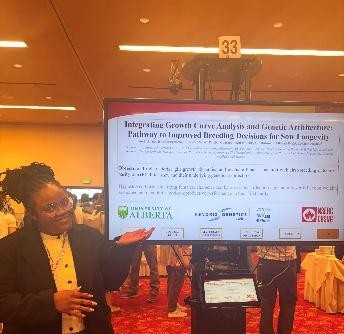
 Attending the World Congress July 12-17, 2026, was, without a doubt, one of the best conference experiences I have had. I went expecting to learn about advances in animal genetics and share my own research, but I left with something much more valuable: new ideas, new connections, and a broader vision for where I could take my career. My research focuses on improving sow lifetime productivity through phenotypic and genomic approaches, intending to improve breeding decisions and sow longevity. I had the opportunity to present a research pitch and an e-poster on my work, “Integrating Growth Curve Analysis and Genetic Architecture: Pathway to Improved Breeding Decisions for Sow Longevity (https://doi.org/10.31274/wcgalp.24211).”
My research asks whether we can move beyond traditional gilt breeding decisions based primarily on age, weight, and heat-no-service and incorporate growth dynamics and genetic information to better understand physiological readiness. Ultimately, I hope this work will contribute to more informed breeding decisions, improved first and subsequent parity performance, and reduced culling risk. Presenting my research was certainly a highlight, but the conversations that followed were even more valuable. I connected with researchers working on both similar and very different questions, and many of these conversations gave me new ideas about how I could approach my own research. I also had the opportunity to speak with genetic companies from around the world and learn about innovations in DNA sampling, phenomics data collection, genetic evaluation, and other emerging technologies.
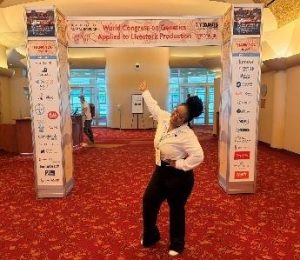 I was particularly impressed by the collaboration between industry and academia. Seeing how research can move beyond the university and into practical applications reinforces something very important to me: I do not want my research to simply sit in an academic journal. I want it to have a meaningful impact on the swine industry, both locally and internationally. The conference gave me greater confidence that this is possible. I was also impressed by the genetic models being developed at the University of Georgia. Seeing the level of innovation in genetic evaluation and the ways researchers are integrating complex data into breeding decisions opened my eyes to areas of animal genetics that I would like to explore further.
Interestingly, one of the most meaningful sessions was not directly related to genetics at all. The organizers included a session specifically focused on navigating graduate school and life beyond the research. Students had the opportunity to ask researchers who had already walked this path about balancing family, marriage, children, friendships, health, finances, part-time jobs, and the demands of a PhD. That conversation was incredibly valuable. Graduate school can sometimes feel chaotic and overwhelming, and it was encouraging to hear that others had experienced similar challenges and had learned, often through trial and error, how to find balance. The discussion also highlighted the importance of having the right supervisor and how significantly that relationship can shape the graduate school experience.
I left the World Congress with more than new research ideas and professional contacts. I left with a renewed vision for my career and greater confidence in the direction of my research. I would encourage students in animal genetics and related fields to attend conferences like this, not simply to add another line to their CV, but to learn, ask questions, make connections, and expose themselves to ideas beyond their immediate area of study.
Sometimes the greatest value of a conference is not the presentation you give, but the new possibilities you discover when you step outside the boundaries of your own research.